Lesson 02
Is there enough bleach in the water — and not too much?
Bleach is measured in parts per million of free chlorine. Below roughly 0.2 ppm the water is no longer protected; above about 4 ppm it stops being pleasant and pushes past drinking-water limits. Here is how to find out where you are.
First, the one distinction that matters
Free chlorine
The chlorine still available to kill germs — hypochlorous acid and hypochlorite. This is the number you want. Measure it, act on it.
Combined chlorine
Chlorine already bound to ammonia and organic matter. It has largely done its work and disinfects weakly.
Total chlorine
Free plus combined. Useful for diagnosis, misleading on its own. Total minus free tells you how much demand the water is putting on your dose.
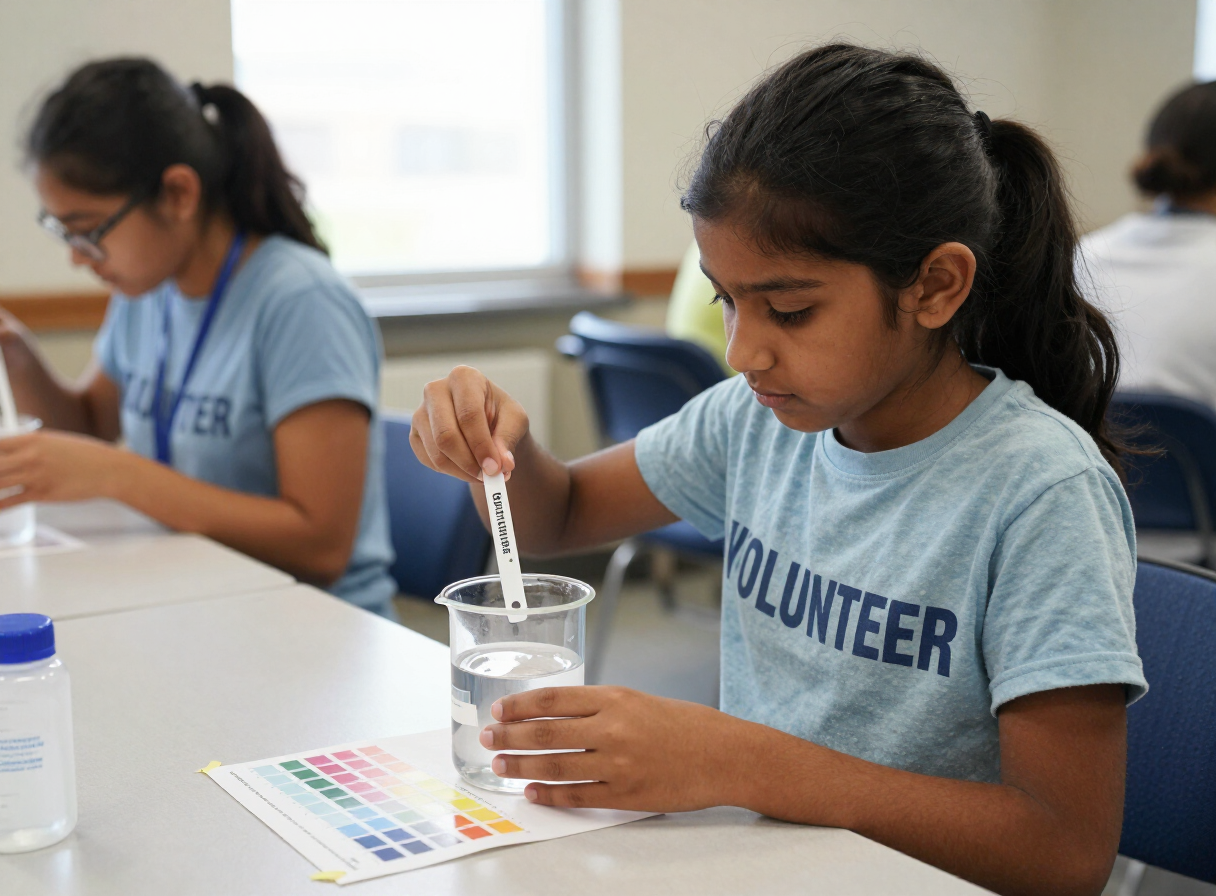
Running the test, step by step
- 1
Collecting sample from swimming pool
We will collect as little as 10 mL of the swimming pool water sample for the bleach concentration testing
- 2
Bleach testing preparation
We will make Leucocrystal solution which will be used for the bleach concentration testing
- 3
Beer's Law
We will use A=ecl (Absorbance equals epilson * concentration * length of cuvette) for specific concentration finding
- 4
Analyzing data
We will perform same experiments at least three times to make sure our data are valid
- 5
Informing the test data
We will inform the test data to the places which requested for our assistance.
Reading the number you get
Colors below are a teaching aid for the shape of the scale — always match against the chart printed on your own strip bottle, since brands differ.
0 ppm · No protection
Nothing is stopping regrowth. Do not treat this water as disinfected.
0.2 ppm · Below target
Some chlorine was added but it has been used up. Re-dose and retest.
0.5 ppm · Minimum in-system
Common lower limit for water sitting in a distribution line or tank.
1.0 ppm · Low target
Little less concentration which can quickly become below target if not maintained well.
2.0 ppm · Upper comfort
Safe, but people will start to notice taste and smell.
4.0 ppm · Regulatory ceiling
The usual maximum residual allowed in public drinking water.
The math
How much bleach for a given volume
Start from the bleach label. Unscented household bleach is usually sold as 5 to 8.25 percent sodium hypochlorite; some labels say "available chlorine" instead, which is a slightly different number, so use whichever the bottle states and note it.
mL of bleach =
(target ppm × litres of water) ÷ (bleach % × 10)
Example: 2 ppm in 20 L using 6% bleach
= (2 × 20) ÷ (6 × 10) = 40 ÷ 60 = 0.67 mL
≈ 13 drops
Then wait at least 30 minutes and measure the actual free chlorine. Dirty or organic-rich water consumes part of the dose, so the measured value is almost always lower than the calculation — the strip, not the formula, is the answer.
Dose calculator
0.67 mL
about 13 drops, or roughly 0.14 teaspoons of bleach — added, stirred, then left at least 30 minutes before testing.
Use only plain, unscented, additive-free bleach, never scented, gel, colour-safe, or splash-less products. Measure in a ventilated space, wear eye protection, and never mix bleach with ammonia, vinegar, or other cleaners. For emergency drinking-water treatment always follow the guidance issued by your local health authority.